
Home / Projects / Borno hubs / Bama
Case study · Humanitarian hub · Bama, Borno State
Solar hybrid power for a humanitarian hub in Bama
85 kWp of new solar and 462 kWh of storage for a humanitarian hub in Bama, built with good equipment we moved from another hub.
Solar
85 kWp
Battery storage
462 kWh
Air conditioners
About 29
Commissioned
Dec 2024
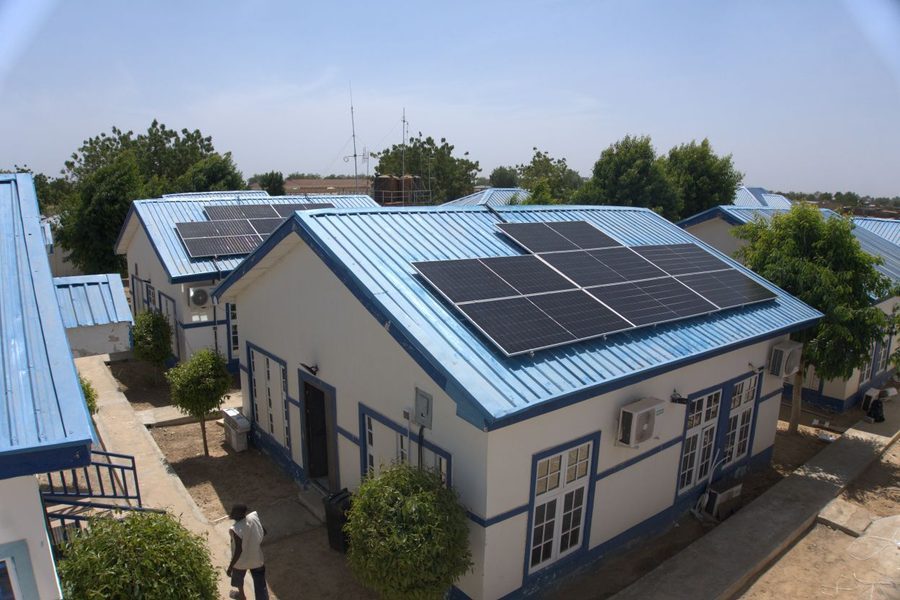
Rooftop solar at one of the eight Borno hubs.
What it powers at the humanitarian hub in Bama
The hub hosts offices, guest rooms and conference space for humanitarian staff. It runs about 29 air conditioners, plus water heaters, kitchen equipment, fridges and freezers, lighting and internet.
How we split the loads
We wired the hub into two circuits, so the things that matter most never go off.
Critical loads: always on
Lights, fans, computers, internet, fridges and security run on the battery 24 hours a day.
Heavy loads: smart control
Air conditioners, water heaters and kitchen equipment switch off when the battery drops to 40% and come back on at 60%.
What we did
✓ Checked the equipment at another hub and kept what was still good: 6 Victron Quattro inverters, 2 Fronius inverters, 9 MPPT charge controllers and 5 BYD batteries
✓ Moved it to Bama and added 25 new BYD batteries and all the connection parts
✓ Installed 136 new JinkoSolar bifacial panels (85 kWp)
✓ Set up remote monitoring on Victron VRM
Full equipment list
• 85 kWp: 136 × JinkoSolar 625 Wp bifacial panels (new)
• 6 × Victron Quattro 15 kVA inverter-chargers (reused)
• 2 × Fronius Symo 20 kW PV inverters (reused)
• 9 × Victron MPPT 250/100 charge controllers (reused)
• 462 kWh storage: 30 × BYD Premium LVL 15.4 kWh (5 reused, 25 new)
• Off-grid AC and DC coupled system with generator backup
• Remote monitoring on Victron VRM
Brands used: Victron · Fronius · BYD · JinkoSolar
How the load control works
We sorted every circuit in the hub with the client's technical team. Critical loads sit on the battery circuit and never go off. Heavy loads sit on a separate, controlled circuit. The system runs everything from full battery down to 40%. At 40%, it switches the heavy loads off and waits for the next morning sun. At 60%, it turns them back on. The generators stay as a manual backup, so the hub team can see and manage how much energy the hub uses.
Part of an eight-hub programme
See the other hubs: Maiduguri · Banki · Monguno · Dikwa · Gwoza · Ngala · Damasak
See the whole programme →
Running a facility on generators?
Tell us about your loads. We'll visit, measure and size a system that keeps the important things on.